Nyepi in a Private Villa: A Practical Guide to Bali's Day of Silence
By Luxe Haven Villas Editorial·
The One Day Bali Stops
Once a year, on the day after the new moon of the tenth Balinese lunar month, the entire island of Bali goes quiet. Not "quiet" as in fewer scooters. Quiet as in: no flights land or depart, no cars move on the roads, shops and restaurants close their shutters, and after dark the island falls almost completely dark. This is Nyepi, the Balinese Hindu Day of Silence, and it marks the beginning of the Saka New Year.
For visitors, Nyepi is either the most frustrating day of a Bali trip or the most memorable one — and which of those you get depends almost entirely on how well you've prepared. Guests who arrive with a plan tend to talk about Nyepi for years afterwards: the silence, the absence of engine noise, the sky. Guests who wandered into it unaware spend it hungry, bored and wondering why the WiFi password stopped mattering.
This guide covers what actually happens, what's expected of you as a guest in a private villa, and how to plan food, staff, arrivals and departures around it.
What Nyepi Actually Is
Nyepi is a day of self-reflection observed through four main restrictions, collectively known as the Catur Brata Penyepian:
- Amati Geni — no fire or light. Traditionally this includes lamps and, by extension, electric lighting.
- Amati Karya — no work or activity.
- Amati Lelungan — no travel or movement outside the home.
- Amati Lelanguan — no entertainment or indulgence.
The Balinese observe these to varying degrees of strictness depending on family and village. Non-Hindu residents and tourists are not expected to fast or meditate, but the restrictions on movement and visible light apply to everyone on the island, including you.
Enforcement is handled by the pecalang, traditional village security officers, who patrol the streets. They are unfailingly polite and completely unmovable. If you step outside your villa gate, you will be asked to go back inside. There is no argument to be had, and honestly, the point is rather lovely once you accept it.
The Day Before: Ogoh-Ogoh and Melasti
Nyepi doesn't arrive out of nowhere. In the days beforehand, you'll see Melasti processions — long lines of villagers in white carrying temple heirlooms to the sea or to holy springs for purification. If you're staying anywhere near the coast, in Seminyak or Canggu especially, these are worth getting up early for.
Then on Nyepi Eve comes the Ogoh-Ogoh parade: enormous, grotesque papier-mâché demons built over weeks by neighbourhood youth groups, carried through the streets on bamboo frames, spun at crossroads to confuse evil spirits, and in many villages burned afterwards. It's loud, chaotic, joyful and genuinely one of the great spectacles of Southeast Asia. Roads close, traffic snarls, and the whole island stays up late.
Then, at 6am the next morning, silence.
The Airport Closes. Genuinely.
This is the single most important logistical fact: Ngurah Rai International Airport shuts completely for 24 hours, typically from 6am on Nyepi to 6am the following day. No arrivals, no departures, no transit. Seaports close too. There is no exception for tourists, and there is no "we'll just take an early flight."
What this means practically:
- Don't book a flight in or out on Nyepi. Airlines generally won't sell them, but if your itinerary involves a connection or a rescheduled flight, double-check the date against the Nyepi calendar.
- Arrive at least two days before, not the day before. Nyepi Eve traffic around the Ogoh-Ogoh parades can turn a 45-minute airport transfer into a two-hour crawl.
- Plan to depart at least a day after. The morning after Nyepi is chaotic at the airport as a full day of backlogged flights unclogs.
- Nyepi falls on a different Gregorian date each year, usually in March. Confirm the date before you lock in flights.
What Happens Inside Your Villa
Here's the good news, and it's the reason so many repeat guests deliberately book around Nyepi rather than avoiding it: inside a private villa, the day is yours.
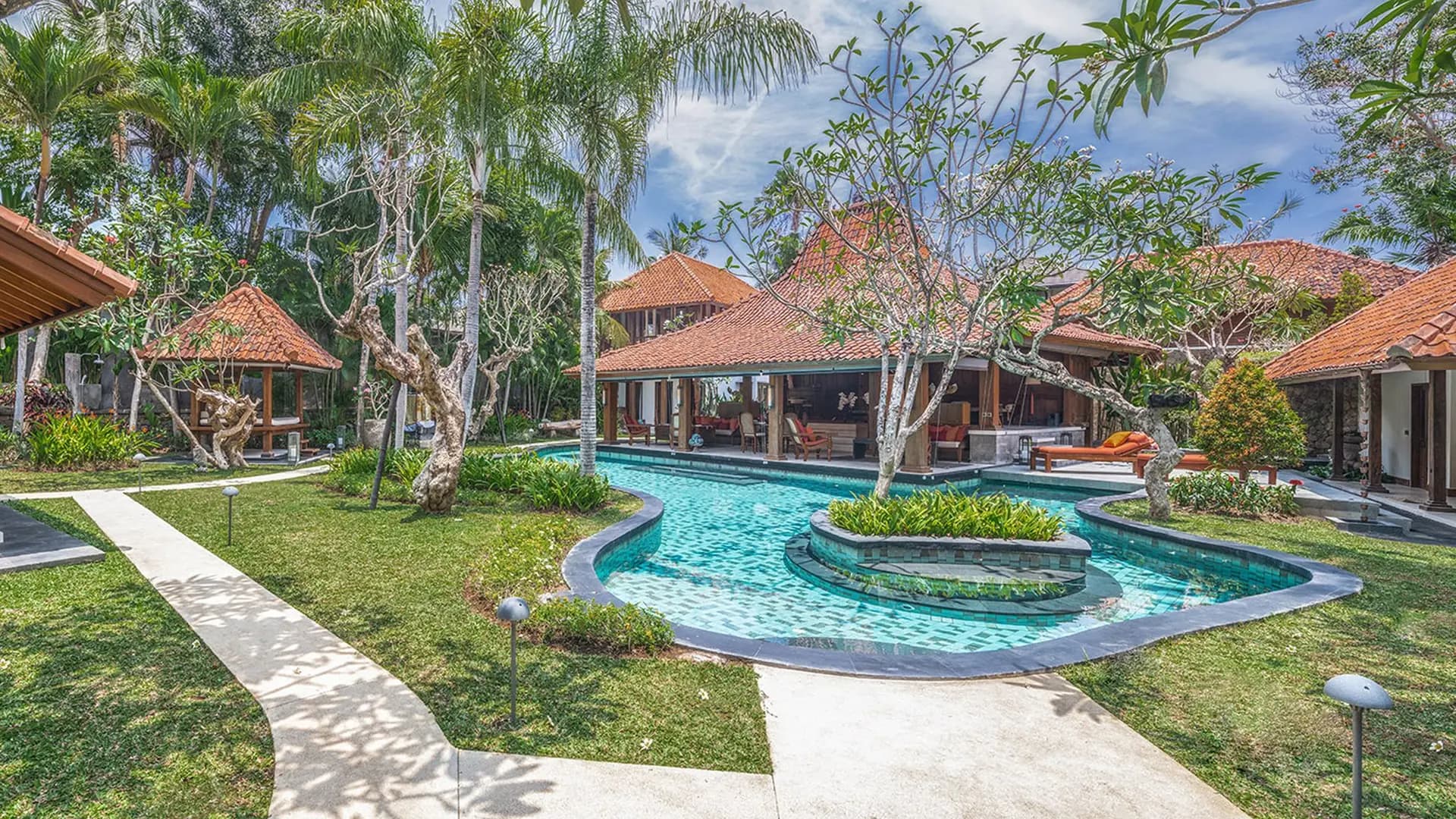
You can swim. You can read by the pool. You can eat, talk, nap and do absolutely nothing with a clear conscience. What you cannot do is leave the property, and after sunset you'll need to keep light from being visible from outside.
In practice that means:
- Keep curtains drawn after dark and use minimal, low lighting inside. Many villas have interior rooms or bathrooms where a soft light is entirely fine.
- No pool lights, no garden lights, no lanterns. Nothing that glows from the street.
- Keep noise down. Music, loud video calls and poolside speakers are out. The silence is the point.
- Some villas voluntarily switch off or restrict WiFi. In recent years, mobile data across the island has been switched off for the 24-hour period by government directive, though implementation has varied. Assume you may be offline and download anything you'll need in advance — books, films, offline maps.
Villas with generous outdoor space make the day dramatically easier. A private pool is the difference between "confined" and "cocooned." Properties like Ubud Jungle Villa or Pererenan Rice View Villa give you a green outlook and water to float in for a day, which is really all you need. If you're travelling as a group and want more room to spread out, larger Seminyak and Canggu properties such as Kayu Aya Boutique Villa or Abaca Villas carry a full day indoors far more comfortably.
Staff, Service and the Human Side
Your villa staff are, in most cases, Balinese Hindus for whom Nyepi is the single most significant day in the religious calendar. It's the equivalent of asking someone to work on Christmas morning — except with the added complication that they are also forbidden from travelling to get to you.
Expect the following:
- Daily housekeeping is suspended. Your villa will be thoroughly serviced the day before.
- Staff who do remain on-site are typically a minimal skeleton presence, often living in staff quarters, and will keep to themselves.
- No deliveries, no maintenance, no transport. If something breaks, it gets fixed the following day.
- Security is still handled, and your villa manager will be reachable by phone where networks allow.
The kindest thing you can do as a guest is to be genuinely self-sufficient for 24 hours and not ask anyone to break the observance. It's also worth thanking your team the day before — a small gesture, warmly received.
Meal Planning: The Part People Get Wrong
There is no food delivery on Nyepi. No restaurants, no warungs, no supermarkets, no Gojek, no Grab. Whatever is in your villa at 6am is what you have until 6am the next day.
Most villas offer a pre-ordered Nyepi meal package — talk to your villa manager at least three or four days in advance. If you're self-catering, here's a realistic shopping list for a two-person, one-day lockdown:
- Breakfast: fruit (papaya, mango, dragon fruit), yoghurt, granola, bread, eggs, good local coffee.
- Lunch: something cold and easy — salads, cold cuts, cheese, crackers, avocado, a pre-made nasi campur or gado-gado that keeps well.
- Dinner: the meal to plan properly. Something that reheats in a single pan, or a rice cooker dish. Avoid anything requiring twenty minutes of chopping under a dim light.
- Snacks and drinks: far more than you think. Plenty of bottled water, plus wine or beer if you drink — though note that some areas restrict alcohol sales in the days around Nyepi.
Shop two days before, not the day before. Supermarkets on Nyepi Eve are a scrum, and shelves thin out fast.
Fully staffed villas with a private chef, such as those in the Seminyak cluster, can usually arrange a set menu prepared in advance and left for you — worth asking about at Oberoi Modern Villa or Double Six Sunset Villa if you'd rather not think about it at all.
What to Actually Do With the Day
Bring a real book. Bring a deck of cards. Bring a notebook. Guests consistently report that the first four hours feel strange and the remaining twenty feel like a gift.
The single best part comes after dark. With the island's lights off and no traffic haze, the night sky over Bali on Nyepi is extraordinary — genuinely one of the clearest you'll see anywhere in the tropics. Step out into your garden, let your eyes adjust for fifteen minutes, and look up. Clifftop and rice-field locations away from the coastal glow, like Uluwatu Clifftop Villa or Ubud Rice Terrace Villa, are especially good for this.
Then, at 6am the next morning, the island exhales. Scooters start. Roosters get their moment. Everything reopens, and Bali picks up exactly where it left off.
A Short Checklist
- Confirm the Nyepi date before booking flights
- Arrive two days early, depart at least one day after
- Order your villa meal package three to four days ahead
- Shop for groceries two days before
- Download offline entertainment and maps
- Charge every device on Nyepi Eve
- Confirm lighting and WiFi arrangements with your villa manager
- Thank your staff the day before
Handled properly, Nyepi isn't an inconvenience to be worked around. It's the one day a year Bali offers something no other destination can — total, island-wide stillness — and a private villa is by far the best seat in the house.
Related articles
 Travel Tips
What a Fully Staffed Villa in Bali Actually Includes — And What It Doesn't
A candid guide to private chefs, butler service, tipping norms and the extra charges nobody warns you about when booking a staffed villa in Bali.